Bibliometric Analysis Findings
Our team conducted bibliometric analyses to find preliminary themes in articles resulting from our initial database searches. Our team queried two databases, Scopus and Compendex, and we loaded all resulting articles into the software VOSViewer. The results from these can be found below.
Scopus Database Analysis
In our Scopus search, 578 articles were found and loaded into software for a bibliometric analysis. In this analysis, we looked at the co-occurrence of terms found in the title and abstract of these articles. There was a minimum threshold of ten occurrences for terms to be found relevant. 109 different keywords met this criteria, and after filtering out redundant words, 105 keywords remained.
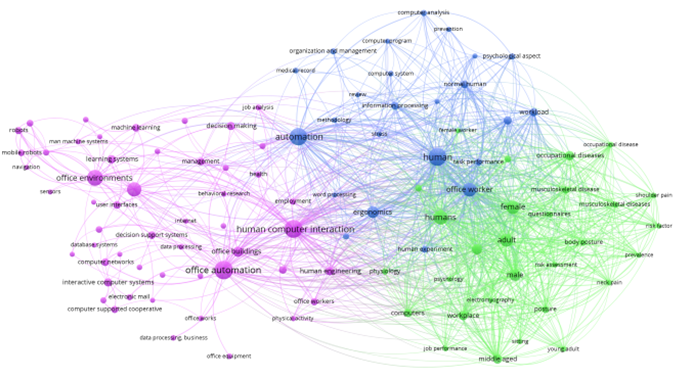
As a results, three clusters of terms were formed. Clusters are organized by grouping frequently associated terms. Within each cluster, keywords are displayed with a circle graphic. The size of the circle signifies the frequency that the keyword was found in titles and abstracts (i.e., larger circles represent terms that were found more frequently). The distances between terms indicate the association strength of those words being used together.
You can see the clusters and the keywords in the graphic above. The green cluster groups terms that are tied to physical tasks and demographics in office work. The blue cluster largely focuses on terms related to cognitive work in the office. The purple cluster highlights themes of automation and technology in the office. Our analysis shows that the green cluster, related to the physical aspects of office work, are well researched as it is very connected to terms within its cluster and terms in other clusters. However, the purple cluster looking at technology and automation appears to be less researched, as there are fewer connections within the cluster and to other themes.
Compendex Database Analysis
In the Compendex database, a general search of office workers was used and yielded 4,075 results. Again, our team chose to look at the co-occurrence of terms in the titles and abstracts. Given the large number of articles in this search, we increased the minimum keyword occurrence threshold to be 20. 242 keywords met this criteria and after filtering out redundant terms, 236 keywords remained.

This analysis resulted in four clusters. The green cluster in the top left focuses on themes of computer technology. The yellow cluster in the top right signifies research done on smart office buildings and the physical office space. The blue cluster groups terms related to robots and automation. The red cluster organizes themes of office work, ergonomics, and office automation. This diagram shows that the yellow and green clusters appear to be less connected to each other than other clusters are. Another insight from this analysis is that more recent research is most often found in the green and yellow clusters compared to the blue and red clusters.
